VLC Media Player Latest Version
VLC Media Player plays a wide range of video and audio files, DVDs, and streams without requiring extra codecs. It is free and open source.
Download VLC for WindowsFree and open source. Also available for macOS, Linux, and Android.
- Free & open source
- No sign-up needed
- Android & PC
VLC Media Player
VLC Media Player is one of those apps almost everyone’s installed at some point, then forgotten it was even there — until you needed it. It’s free, open-source, and honestly just plays whatever you throw at it. You know that file your default player refuses to touch? VLC opens it without complaint. Music, subtitles, playlists, switching between audio tracks, speeding up a two-hour lecture so you can actually finish it — it’s all in there, and none of it costs you anything.
VideoLAN is behind it, and there are proper official versions for Windows, Mac, Linux, Android, iOS, and a few other platforms too. The best part? Honestly, you don’t even need to touch a setting. Install it, double-click your file, and you’re watching — that’s it. But if you like poking around under the hood, there’s a lot more waiting than most people ever discover.
So let’s go through it properly: what VLC actually is, how it works, the formats and devices it supports, the features worth knowing about, how to download and install it, how to use the basics, what it does with your data, how updates work, and the handful of problems people usually run into — along with how to sort them out.
What Is VLC Media Player?
It’s a free, open-source media player — VLC Media Player, to be exact — built to work across pretty much every major platform, and one of its biggest strengths is that it just plays things. Most common video and audio formats work right out of the box — no hunting down separate codec packs like you might need with other players.
Day to day, that means you can throw movies, TV episodes, music, recordings, downloaded videos, or whatever else is sitting on your drive at VLC Media Player, and it’ll usually just open. It can also handle network streams and even certain physical discs, if you still deal with those.What really sets VLC Media Player apart is just how flexible it is. Want to hit play and not think about anything? Go for it — you absolutely can.
But if you want to dig in, there’s a full layer of controls underneath — subtitles, audio tracks, video filters, sync adjustments, playlists, streaming setups, all of it.And because it’s built for so many operating systems, you get roughly the same experience whether you’re on Windows, Mac, Linux, or your phone. On Android, the VLC Media Player APK brings the same familiar playback experience to your phone, which is genuinely useful if you bounce between devices a lot.
How Does VLC Media Player Work?
Basically, when you open a file in VLC, it peeks inside the container to see what’s there — video, audio, subtitles — and then plays back whatever it’s able to decode. These files can hold more than you’d think. There might be one video stream or several, a bunch of different audio tracks (handy if you want a different language), a few subtitle options, plus metadata and other extra info tucked away inside.
If there’s more than one audio or subtitle track, no problem — you just pick the one you want right there while it’s playing.VLC will also stream stuff over a network, provided the format works with it. But how well that goes depends on a few things: the stream itself, your internet connection, the server on the other end, and how much your device can handle.
One thing people don’t always realize — the file extension doesn’t really tell you much. Two .mp4 files can be built totally differently under the hood, using different codecs — so one plays without a hitch while the other just won’t cooperate. And even with formats VLC normally has no trouble with, a file that’s corrupted, cut off partway, or encoded in some odd way can still refuse to play.
VLC Media Player Features
Core Playback
VLC handles pretty much any format you throw at it without needing extra codec packs — think MP4, MKV, AVI, FLAC, and plenty more, all working right out of the box. It’s also solid with streams, internet radio, and DVD/Blu-ray playback, though Blu-ray discs can sometimes run into trouble because of DRM restrictions.
Playback Controls
VLC lets you slow down or speed up playback without affecting pitch. Frame-by-frame stepping offers precise control, A-B looping repeats sections on demand, and fixing audio/video sync issues is simple too.
Audio and Video Adjustments
VLC includes a built-in equalizer plus effects like compressor and normalization for better sound. On the video side, you can adjust brightness, contrast, hue, saturation, and gamma to perfect the picture.
Video Features
VLC offers filters like deinterlacing and cropping for better quality. Subtitles auto-load when filenames match, with adjustable timing and fonts. Grab screenshots anytime, and convert audio or video formats easily.
Streaming & Casting
VLC streams directly to Chromecast without extra apps and can act as a server for other network devices. It also supports capture devices like webcams and capture cards, making it versatile for streaming.
Recording & Conversion
VLC can record media while it plays — perfect for saving live streams. Its built-in converter switches formats easily, and it can even rip DVDs into video files for permanent storage.
Customization
VLC lets you customize its look with skins, offers tons of keyboard shortcuts for quick control, supports Lua scripting for plugins and extensions, and gives you advanced sorting options to keep playlists organized.
Simple and Advanced Interface
VLC offers a clean, simple interface for everyday playback, plus an Advanced Controls toolbar with extra buttons like record and frame-by-frame. Preferences also have a “Simple” and “All” (advanced) view for deeper customization.
Cross-Platform Availability
VLC runs on Windows, macOS, Linux, Android, iOS, and even some smart TVs, offering a consistent interface and feature set across devices. This makes it easy to use the same player everywhere you watch or listen.
What VLC Can Play
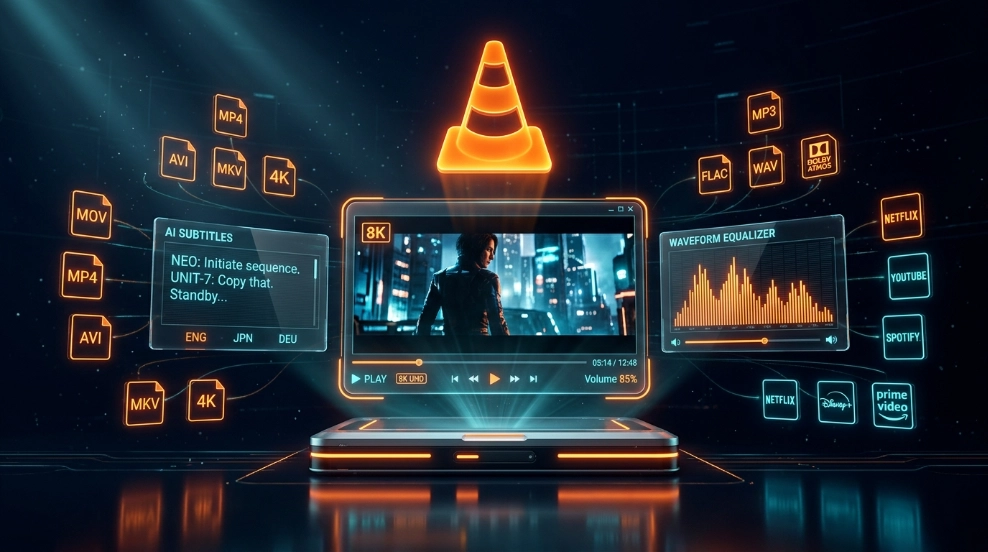
VLC has this reputation for just working — no matter how weird or old the file is, chances are it’ll open it. Here’s a look at the formats you’ll bump into most often:
| Format | Where You’ll See It |
| MP4 | Phone videos, streaming downloads, general everyday video |
| MKV | Movies, especially ones with multiple audio tracks or subtitles |
| AVI | Older video files from years past |
| MOV | Videos from iPhones and other Apple devices |
| WebM | Video pulled from websites |
| MP3 | The classic compressed music format |
| FLAC | High-quality, lossless audio |
| WAV | Raw, uncompressed audio |
And that’s really just scratching the surface — VLC handles dozens of other formats too, depending on your device and what’s installed under the hood.
Container vs. Codec — What’s Actually the Difference?
Honestly, these two trip people up all the time, so let’s clear it up in plain terms:
Think of a container (like MP4 or MKV) as a box. It holds everything together — the video, the audio, subtitles, whatever else — in one neat package. The codec is what’s actually happening inside that box — it’s the method used to compress and decompress the video and audio.
This is why two MP4 files can act totally differently even though they look identical on the outside. One plays smoothly, the other stutters or won’t open at all — because what’s packed inside them isn’t the same.
When a File Won’t Play
If something that should work suddenly doesn’t, it’s almost always one of these culprits:
- The file itself is broken — maybe the download got cut off or the transfer failed halfway
- The extension is lying to you — someone renamed a file, and it’s not really what it claims to be
- The codec is too obscure — VLC (or your version of it) just doesn’t know how to decode it
- Sometimes it’s none of the above — just an outdated VLC version, a plugin that didn’t install right, or your OS being weird about something
Not sure where to start? Pop the file open in VLC and head to Tools → Codec Information. It’ll spell out exactly what you’re working with, and from there the fix is usually pretty obvious.
VLC Media Player for PC
VLC Media Player is a solid choice for handling media on your PC — whether you’re watching videos, listening to music, or organizing a personal collection of recordings.
It can open files straight from your internal storage, a USB drive, or basically anywhere your operating system can see. If you’ve got a bunch of files you want to play one after another — like TV episodes, a music album, or a stack of home videos — you can just add them all to a playlist and let VLC run through them in order.
And if you use it often, it’s worth learning the keyboard shortcuts and playback controls — little things like skipping ahead, adjusting speed, or toggling subtitles become a lot faster once they’re second nature.
VLC Media Player for Windows 10 and Windows 11
Windows users are all set with VLC as well — it runs smoothly on both Windows 10 and 11.After you install it, opening files is easy: just double-click them in File Explorer, or open VLC first and pick the file from there.
One thing worth knowing — how well it plays depends partly on your computer. Most regular videos will play just fine, but if you’re dealing with 4K or high-bitrate files, an older or weaker machine might start chugging a bit.
One more thing — grab VLC directly from VideoLAN’s official site. Some third-party download sites like to sneak in extra software you didn’t ask for, so it’s just safer to go straight to the source.
VLC Media Player for Mac
If you’re on a Mac, VLC’s got you covered too. It handles all the basics — local video and music playback, subtitles, playlists, and streaming from supported sources.
Visually it’s tailored to fit in with macOS rather than looking like a straight port from Windows, but under the hood, you’re not missing out on any functionality.
VLC Media Player for Linux
VLC works on Linux too. Most major distros support it, and you can use it for playing local videos and music, handling subtitles, managing playlists, and streaming compatible network content.
How you install it depends on your distro — some (like Ubuntu or Debian-based systems) let you grab it straight from the software center or with a quick, while others might need you to add a repo first. If you let me know which distro you’re on, I can give you the exact install steps.
VLC Media Player for Android
VLC for Android puts most of what makes VLC great on your phone or tablet. You get video and audio playback, subtitle support (including multiple tracks), a built-in media library, an equalizer, various filters, and the ability to stream over your network — plus hardware decoding on devices that support it. Basically, you can watch or listen to your files directly on your phone without ever plugging it into a computer.
That said, how smooth it runs really depends on your device — older or budget phones with weaker processors or graphics chips may struggle more than newer, high-end ones. VLC also has versions built for Android TV boxes and Chromebooks, so it’s not just limited to phones and tablets.
VLC Media Player Download and Installation
If you want to download VLC Media Player, use the official VideoLAN website whenever possible.
Official VLC releases are available for several supported platforms, including Windows, macOS, Linux, Android, and iOS.
How to Download VLC Media Player
Follow these general steps:
- Identify the operating system on your device.
- Open the official VideoLAN VLC download page.
- Select the package that matches your device.
- Download the installer or application.
- On a computer, open the downloaded installer.
- Follow the installation instructions.
- Launch VLC after installation.
- Test the player with a known working media file.
Download options can vary by platform and system architecture.
Avoid unfamiliar download pages with multiple download buttons. Modified or unofficial installers may contain software that is not part of the original VLC project.
How to Use VLC Media Player
VLC is straightforward for basic playback. Most users can start watching a video without changing advanced settings.
Basic Video Playback
Open VLC and select a compatible video file.
During playback, you can:
- Pause or resume the video
- Stop playback
- Move through the timeline
- Skip to another part of the video
- Change playback speed
- Switch to full-screen mode
You can also add multiple files to a playlist for continuous playback.
Audio and Volume Controls
Use VLC’s volume control to increase or reduce the sound.
If a video contains several audio tracks, open the audio options and select the track you want. A movie may contain an original language track, a dubbed version, or commentary.
If there is no sound, check both VLC’s volume and your operating system’s selected audio output.
VLC also includes an equalizer and other audio settings. These can be useful when listening to music or adjusting different frequency ranges.
Subtitles
VLC supports subtitles included inside a media file as well as separate subtitle files.
If a video has multiple subtitle tracks, you can select the available track during playback.
For external subtitles, load the compatible subtitle file through VLC’s subtitle options.
If subtitles appear too early or too late, VLC provides synchronization controls that can adjust their timing.
Playback Speed
VLC lets you slow down or speed up playback.
Slower playback can be useful when following instructions, studying a recorded lesson, or checking a particular scene.
Faster playback can help when reviewing familiar material or moving through a long recording.
Full-Screen Mode
Full-screen mode gives the video more space on your display by hiding most of the normal interface.
It is useful for movies, tutorials, presentations, and other videos. You can return to the normal window whenever you need access to menus or other applications.
Playlists
A playlist lets you place multiple media files into one playback queue.
You can add files, change their order, remove individual items, and play them one after another.
For example, you can create a playlist for:
- TV episodes
- Music tracks
- Recorded videos
- Movies
- Personal media
Removing a file from a playlist does not normally delete the original file from your storage.
VLC Media Player Network Streaming
VLC can play certain network streams in addition to local media files.
With network playback, VLC receives media from a compatible source instead of reading the entire file from local storage.
The experience can depend on:
- Internet or local network speed
- Stream quality
- Server availability
- Supported protocols
- Device performance
A high-quality stream generally requires more bandwidth. An unstable connection can cause buffering, pauses, or interruptions.
VLC can also be useful in some home-network setups where media is stored on another computer or compatible network storage device.
VLC Media Player Settings and Shortcuts
Most users can leave VLC’s default settings unchanged.
Advanced users can explore settings related to:
- Video output
- Audio output
- Subtitles
- Interface behavior
- Filters
- Hardware decoding
- Playback preferences
Keyboard shortcuts can make common actions faster. The exact shortcuts can vary by platform and configuration, so check the shortcut list in your installed version when a particular command matters.
If VLC is already playing your files correctly, there is usually no need to change advanced settings.
VLC Media Player Problems and Solutions
Playback problems can come from the media file, device hardware, audio settings, network conditions, or other configuration issues.
VLC Video Has No Sound
Check the following:
- VLC volume
- System volume
- Mute status
- Selected audio track
- Selected audio output device
Try playing another media file. If the second file has sound, the problem may be specific to the original file.
VLC Video Is Lagging or Stuttering
High-resolution video, demanding codecs, damaged files, or limited hardware can cause playback problems.
Try another video to determine whether the issue affects every file.
On supported systems, hardware decoding may improve playback for some demanding videos.
If the problem only happens with one file, the media itself may be damaged or encoded in a way that places greater demands on the device.
VLC File Will Not Open
First, check whether the file is complete and whether it works in another compatible player.
A damaged or incomplete download can fail even when VLC normally supports the format.
Also check the file extension and source. An incorrectly renamed file may not actually contain the format suggested by its extension.
VLC Subtitles Are Out of Sync
Use VLC’s subtitle synchronization controls to move the subtitle timing closer to the dialogue.
If the problem continues throughout the entire video, the subtitle file may not match that particular version of the video.
VLC Audio and Video Are Out of Sync
Audio and video synchronization problems can come from the source file, decoding, hardware performance, or playback conditions.
Try another media file first. If the problem only occurs with one video, the file may be the main cause.
Is VLC Media Player Free?
Yes. VLC Media Player is free and open-source software.
You do not need a subscription to use its standard playback features.
VLC is available across several supported platforms, including Windows, macOS, Linux, Android, and iOS.
Because VLC is open source, its source code is publicly available as part of the project.
Is VLC Media Player Safe?
The safest approach is to download VLC from VideoLAN or another trusted official distribution channel.
The official VLC project states that its software is distributed without spyware and advertising. However, the source of the installer still matters. An unofficial modified build is not necessarily the same software provided by the original project.
For safer installation:
- Use an official download source.
- Avoid modified VLC installers.
- Be careful with fake download buttons.
- Keep your operating system updated.
- Scan unexpected installer files when appropriate.
Using the original application from a trusted source can reduce the risk of installing unwanted software alongside the media player.
VLC Media Player Privacy
For normal local playback, VLC can play compatible files stored on your device without requiring a streaming account.
Privacy can be different when you use network streams or external media sources. The service or server providing the stream may collect information independently of VLC.
For this reason, pay attention to the source of any network stream you open and avoid connecting to unknown services.
Using an official VLC release also helps ensure that you are using software from the original project rather than an unofficial modified version.
VLC Media Player Update
Keeping VLC up to date is a good habit — it usually brings better compatibility, fewer bugs, security patches, and general under-the-hood improvements. Here’s a decent way to go about it: first, take a look at what version you’re currently running. Then just pop over to VideoLAN’s site and see what’s changed lately. Grab whatever package matches your system, install it the way you normally would, and if it wants a restart, just go with it. Once it’s back open, run a couple of files you already know so you can be sure everything’s still behaving properly.
And honestly, don’t go in expecting some big flashy redesign with every update — most of the time, it’s really just about fixing bugs, patching up security stuff, or general behind-the-scenes upkeep.
VLC Media Player Compatibility and Hardware Requirements
What VLC needs to run well really comes down to a mix of things — your operating system, the version of VLC you’re using, the type of media file, and the device itself. For basic playback, you honestly don’t need much; even older or modest hardware handles it fine. But once you start throwing high-resolution or high-bitrate videos into the mix, that’s when things get more demanding on your system.
A few things worth keeping in mind:
- Operating system – make sure the VLC version you download actually supports your platform
- Processor – decoding complex video files can push your CPU harder
- RAM – how much memory you’ve got free plays a big role in overall performance
- Graphics hardware – hardware decoding can take some of the load off for demanding videos
- Storage – large media files need enough space to sit on your drive
Even two devices running the same OS can perform pretty differently just because of hardware differences. So rather than fixating on some official “minimum spec,” it’s more useful to think about what kind of content you’re actually planning to watch — a standard video file is way less demanding than a 4K or high-bitrate one.
Using VLC With Downloaded Videos
VLC will happily play whatever video files you’ve got saved on your computer or phone — and honestly, it supports so many formats that compatibility is rarely an issue. But it’s worth remembering: VLC is only a player, not where your content actually comes from. It doesn’t grant you any rights to download copyrighted stuff, and it has zero say in whether the website you got a movie or show from actually had the legal right to share it.
So if you’ve legally acquired a video and it’s in a compatible format, VLC will play it without issue. Simple as that — where you get your content from is on you, while VLC’s only job is making sure it plays smoothly once you have it.
VLC Media Player Alternatives
VLC does the job for most people, but if yours keeps annoying you, there are plenty of alternatives. Here are the ones I’d look at.
PotPlayer is my pick if you like fiddling with settings. It only runs on Windows, and the first time you open the settings menu you’ll probably wonder what you’ve gotten yourself into. But it plays 4K smoothly, handles subtitles really well, and you can adjust nearly everything. Just watch the installer for bundled extras.
mpv barely has an interface. You open a video and it plays, and that’s about it. It’s free, works on almost every system, and looks great once you’ve set it up. You’ll be dealing with a config file and keyboard shortcuts, so it suits people who like that sort of thing.
MPC-BE is for anyone who just wants a player that works. It’s a small, no-frills Windows app that looks like the old Media Player Classic, and it runs fine on older computers.
GOM Player has a more familiar, traditional look and copes with most common formats. Its subtitle tools are handy too. Be aware that the free version shows some ads.
Windows Media Player is already on your PC, so there’s nothing to install. It’s fine for everyday music and videos, though it won’t cope with as many formats as VLC.
If you’re still undecided, try PotPlayer if you want control, mpv if you want speed, and MPC-BE if you want something simple.
Pros and Cons
Pros
- It’s totally free, and always will be — no premium tier hiding features behind a paywall
- Throw pretty much any video or audio file at it and it’ll just play, no need to hunt down codecs
- Runs on Windows, macOS, Linux, and your phone too (Android/iOS)
- You’ll never get hit with a subscription fee
- Subtitles and multiple audio tracks just work, no fuss
- Handy for more than playback too — it can stream and convert files when you need that
Cons
- The interface still looks like it’s from another era, not the sleekest
- Beginners might get lost in the settings menu — there’s a lot going on in there
- 4K or heavy bitrate files can chug on older or weaker laptops
- Occasionally some DRM-locked content (think certain paid streams) just refuses to play
Frequently Asked Questions
Conclusion
VLC Media Player has stuck around for a reason — it just works, no drama. You don’t need to go digging for codecs or cross your fingers hoping a weird file format will open; chances are, it’ll play. And once you get past the basics, there’s actually some solid stuff under the hood — subtitle adjustments, the ability to flip between audio tracks, speed controls, even a fix for when your audio and video decide to drift apart.
None of it gets in your way if you don’t need it, but it’s nice knowing it’s there. It won’t cost you anything, doesn’t hog your system, and runs on pretty much any platform you’re using. Just make sure you grab it straight from VideoLAN’s site, and keep your media sourced legitimately.